Nets & Mats That Survive Real Practice
The two least glamorous purchases in your setup decide whether you practice daily or quietly stop. How to choose a net that contains real golf balls and a mat that does not wreck your elbows.
How we make money: some product links in The Lab are affiliate links, and we may earn a commission if you buy through them — at no extra cost to you. Rankings are never for sale. Recommendations are based on published specifications, independent measurement reports and owner feedback, and prices were checked in October 2026; retailers change them often. Chasing Pins is a participant in the Amazon Services LLC Associates Program, an affiliate advertising program designed to provide a means for sites to earn advertising fees by advertising and linking to Amazon.com. As an Amazon Associate, Chasing Pins earns from qualifying purchases.
Nobody dreams about a hitting mat. But talk to golfers a year into home practice and the stories split cleanly: the ones still practicing bought a net that sets up in seconds and a mat with real give; the ones who quit are nursing a sore lead elbow from a $60 mat on concrete, or they got tired of fetching balls from behind the couch.
Nets: contain, return, disappear
A home net has three jobs. Contain a mishit at driver speed — look for a target sheet plus side barriers, because your worst ball, not your average one, decides what breaks. Return the ball, or at least gather it, so a 20-minute session is 60 balls and not 15 balls and five scavenger hunts. Disappear — pop-up frames earn their premium every single session.
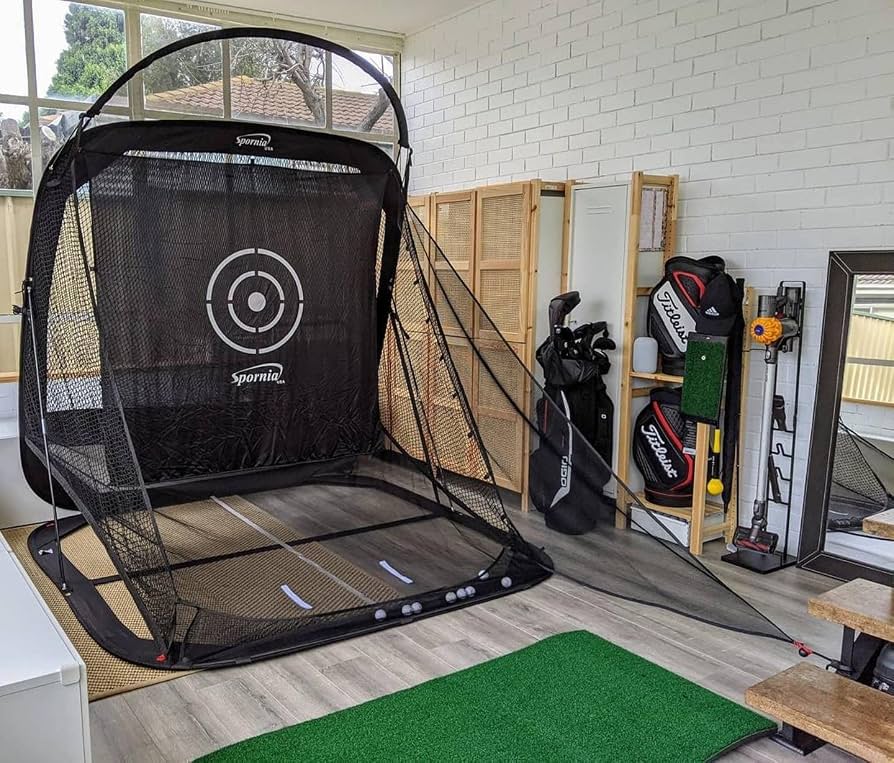
Spornia SPG-7
- 7 ft × 7 ft
- Pop-up, ~30-sec setup
- Automatic ball return
- Indoor + outdoor
The net we recommend first: it pops up in seconds, rolls balls back to your feet, and the target sheet keeps garage sessions quiet enough to be sustainable.
Step up to the Spornia SPG-8 ($499.99) if you are tall, hit high wedges indoors, or just want the extra margin — it is the same design at 8 feet with tournament-grade coverage. At the permanent end, The Net Return Pro Series V2 (roughly $600–800 depending on configuration) is the buy-once frame net: rated for 250,000 shots, automatic return, and the standard choice for dedicated sim rooms that skip an impact screen.
Mats: the joint-protection rule
Thin mats on hard floors are the number one cause of “golf elbow” in home practice. The club’s energy has to go somewhere; good mats absorb it in fibre and foam, cheap mats send it up your arms. Our floor for a daily-use mat is about $400–500, and the honest test is simple: hit 30 fat 7-irons. If your wrists are talking to you, the mat failed.
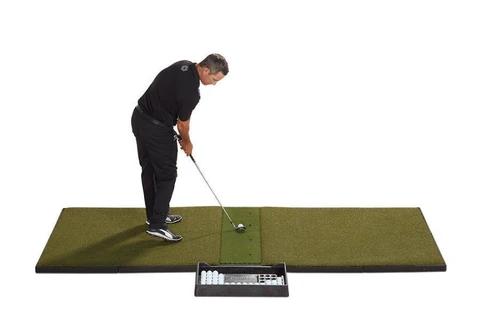
Fiberbuilt Grass Series (7′ × 4′)
- Bristle-fibre hitting strip
- Modular base
- Real tees
- Replaceable strip
The mat for high-volume practice: the bristle strip lets the club move through instead of bouncing off, which your elbows and wrists will notice by week three. The hitting strip is replaceable, so it is a decade-long purchase.
The middle tier is genuinely good in 2026. The Country Club Elite 5′ × 5′ ($479) is the commercial-range mat shrunk for home: spring-crimped nylon over 5/8″ high-density foam, takes a real tee, and shrugs off weather if your setup lives outside. The SIGPRO Softy 4′ × 7′ ($999.99) is the softest landing in the business — the pick if your joints already complain — and Carl’s HotShot (from about $500) wins on replaceable hitting strips, the feature that makes a mat a ten-year purchase instead of a two-year one.
The Lab verdict
Most homes: Spornia SPG-7 + the best mat you can afford. Permanent room: Net Return Pro or an impact screen, and a Fiberbuilt or SIGPRO Softy under your feet. Whatever you choose, never hit full shots off a thin mat laid directly on concrete — that is not a budget decision, it is a physiotherapy subscription.