Putting at Home: Mats That Roll True (and the Ones That Lie)
Putting is the cheapest skill in golf to practice and the easiest to practice wrong. What stimp, surface and ball return actually do to your stroke — and the two mats worth your floor space.
How we make money: some product links in The Lab are affiliate links, and we may earn a commission if you buy through them — at no extra cost to you. Rankings are never for sale. Recommendations are based on published specifications, independent measurement reports and owner feedback, and prices were checked in October 2026; retailers change them often. Chasing Pins is a participant in the Amazon Services LLC Associates Program, an affiliate advertising program designed to provide a means for sites to earn advertising fees by advertising and linking to Amazon.com. As an Amazon Associate, Chasing Pins earns from qualifying purchases.
Most putting practice fails quietly: the mat rolls at a speed nothing like your home course, so the stroke you groove all winter is calibrated to a surface that does not exist. Fix the surface first, then the reps mean something.
The three numbers that matter
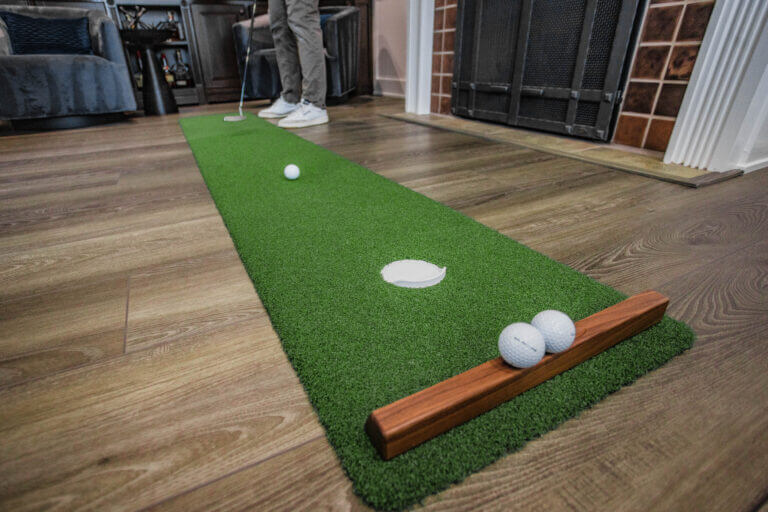
Stimp. You want 10–11 — the speed of a good club green. Budget mats often run 12–14 on hard floors, which trains a tentative stroke. True roll. The ball should not bounce or skate in the first foot; foam and velvet surfaces beat cheap woven plastic. Width. Narrow mats (about 1 ft) mean you stand beside them, which changes your posture slightly; wide greens let you stand on the surface. Neither is fatal — consistency of setup matters more.
Perfect Practice V5 (Standard)
- 9.5 ft
- Rolls at stimp 10–11
- Automatic ball return
- Two cup sizes
The mat most golfers actually keep using: a true roll at a realistic speed, made putts return to your feet, and a reduced-size cup that makes 6-footers at home feel harder than 6-footers on the course.
BirdieBall Deluxe Putting Green 4′ × 14′
- 4 ft × 14 ft
- Stimp 10–11, adjustable
- Real drop-in cups
- Add shims for break
If you have the floor space, this is the closest thing to a real green indoors: aerated-foam surface, genuine grain you can brush faster or slower, and cups you can move — including breaking putts with the included shims.
A 15-minute putting session that transfers
Whatever mat you own, structure beats volume. Gate work (5 min): putt through two tees a ball-width apart from 4 feet — start-line skill, nothing else. Ladder (7 min): one ball each at 4, 6, 8 and 10 feet, in order, twice through; you are training pace, not makes. Pressure finish (3 min): five 5-footers, and the session does not end until you make all five in a row. That last rule is the whole game — it manufactures the exact feeling The Mind pillar is about.
Buying order for a home short-game corner: true-rolling mat first, a dozen of the balls you actually play second, a putting mirror third. Total damage under $200, and it will save you more strokes than any single club in the bag.