The 9-Foot Ceiling Simulator: Swing Math, Monitors and the Build That Fits
Nine feet is workable for most golfers and wrong for some. The clearance table by height and club, the monitor types a low lid rules in and out, and the projector placement that keeps it out of your follow-through.
How we make money: some product links in The Lab are affiliate links, and we may earn a commission if you buy through them — at no extra cost to you. Rankings are never for sale. Recommendations are based on published specifications, independent measurement reports and owner feedback, and prices were checked in October 2026; retailers change them often. Chasing Pins is a participant in the Amazon Services LLC Associates Program, an affiliate advertising program designed to provide a means for sites to earn advertising fees by advertising and linking to Amazon.com. As an Amazon Associate, Chasing Pins earns from qualifying purchases.
Nine feet is the ceiling in half the garages in America, and the most argued-about number in simulator planning. The arguments usually start with the screen. They should start with the swing: at 9 feet, the equipment is rarely the problem — the arc of your longest club is. Here is the math, club by club, and the build that respects it.
First, the swing math
At the top of the backswing, your hands sit roughly 15–20% above your height, and the club extends that line. Work through the installer guidance used across the industry and a consistent table emerges:
| Your height | Minimum ceiling | Comfortable |
|---|---|---|
| Under 5′6″ | 8′6″ | 9′0″ |
| 5′6″ – 5′9″ | 9′0″ | 9′6″ |
| 5′10″ – 6′0″ | 9′6″ | 10′0″ |
| 6′1″ – 6′3″ | 10′0″ | 10′6″ |
| Over 6′3″ | 10′6″ | 11′0″ |
By club, the driver is the test case — at 45.5″ it is the longest lever you own. A 3-wood runs about 2 inches shorter and peaks roughly 2 inches lower; a 7-iron (37″) peaks something like 8 inches below your driver arc; wedges lower again. So a 5′10″ player under a true 9-foot ceiling typically owns a comfortable irons-and-wedges room and a maybe driver room — and “maybe” is settled by testing, not optimism. Make slow driver swings and mark the arc’s peak with painter’s tape before you spend anything. Two measurement rules matter more than any table: measure to the lowest obstruction in the swing path — beams, garage-door tracks, light fittings — and subtract what you add. A mat takes 1–2 inches off the floor; a ceiling-mounted projector can hang 6 inches into the room. A raw 9′0″ can be an honest 8′4″ of swing room by the time the room is built.
Monitors: floor units win at 9 feet
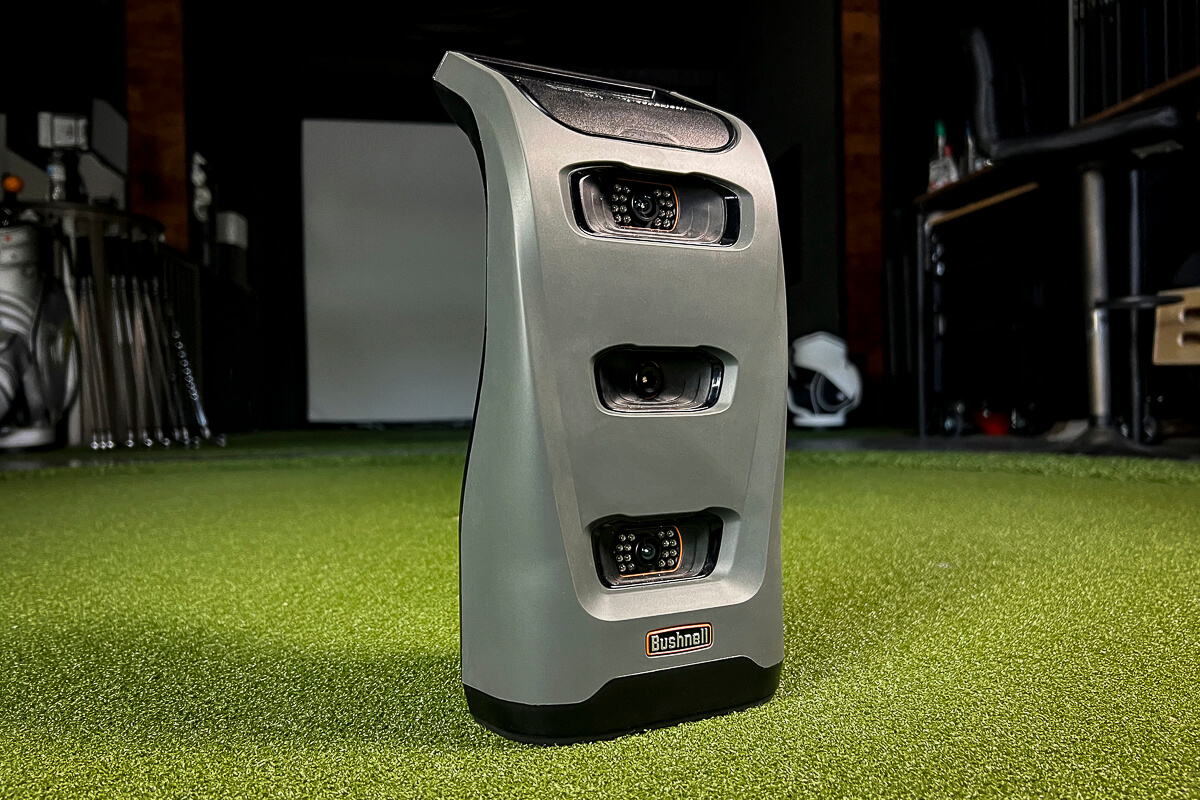
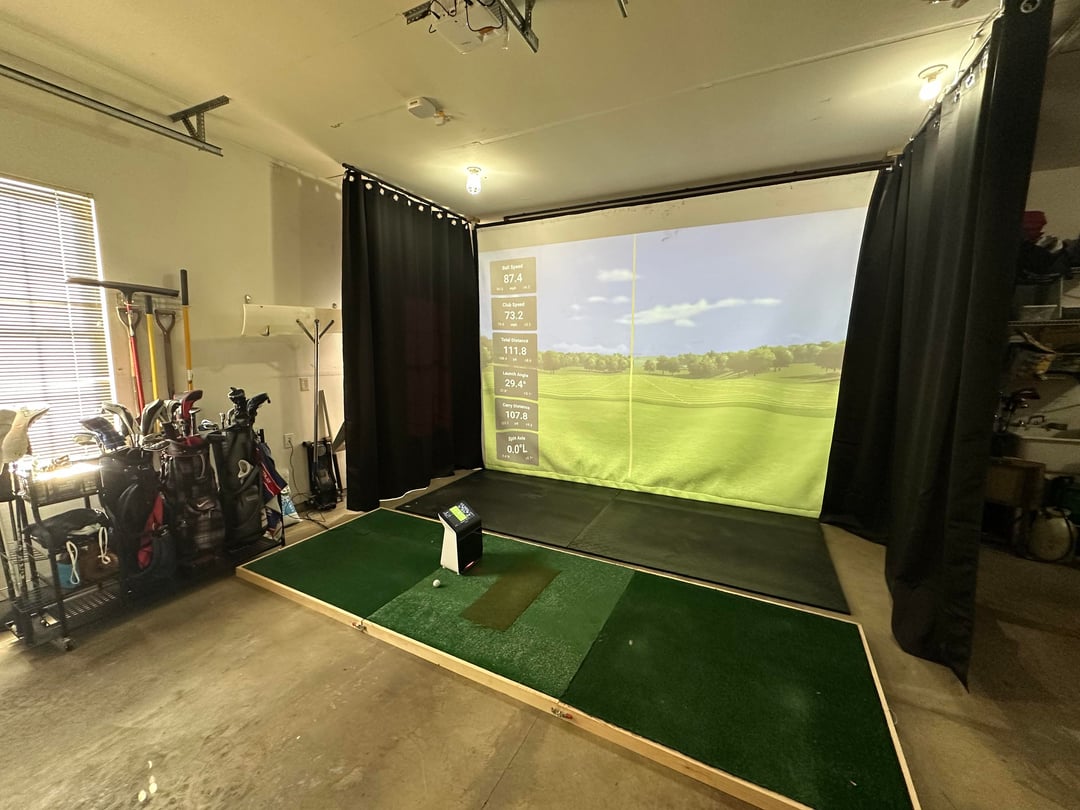
Here is the good news: ceiling height barely matters to the monitor classes that live on the floor. Photometric units — the EYE MINI LITE, the SkyTrak+, the Launch Pro — sit beside the ball, photograph impact, and ask nothing of the ceiling; they also free you from radar depth, so a room of about 12–13 feet does the whole job. Radar units behind the ball (R10, MLM2PRO) are equally indifferent to the lid but need 14–16 feet of depth to breathe. Overhead units are the ones a 9-foot ceiling actually rules out. Uneekor’s EYE XO line specifies a mounting height of 9–10 feet — at exactly 9 you are at the floor of the specification, with the unit still hanging below it into your arc — and TrackMan’s iO asks for 9′4″ minimum. At 9 feet, buy the floor.
Uneekor EYE MINI LITE
- Dual camera
- 19 data points
- Club Optix impact replay
- No subscription for data
Camera accuracy and full club data at the lowest price that gets you both. It is wired, stationary and PC-only — perfect for a permanent bay, wrong for the range.
SkyTrak+ (ST+)
- Photometric camera + dual radar
- Club path & face measured
- Sits beside the ball
- Course play needs a paid plan
A discontinued flagship at a mid-tier price: measured ball and club data from beside the ball while closeout stock lasts. The catches are the plan ladder — course play rents by the year — and no angle of attack at any tier.
Net or screen under a low lid
A net asks the least of a short room. The SPG-7 stands 7 feet tall and fits under any ceiling in this conversation; its bigger sibling, the SPG-8 at 8 feet, still clears a true 9-foot lid with its frame arc accounted for. Screens are where 9 feet gets tight: most enclosures stand 8′4″ or more before anything is tensioned, so measure the frame, not the fabric — and expect the projected image to top out around 7½ feet tall, which suits a wide, shorter picture better than a towering one. Plenty of excellent 9-foot rooms skip the argument entirely and hit into a net in front of a large television; immersion is lovely, but it is not the part that lowers scores. Our nets & mats guide covers the containment side of the decision.
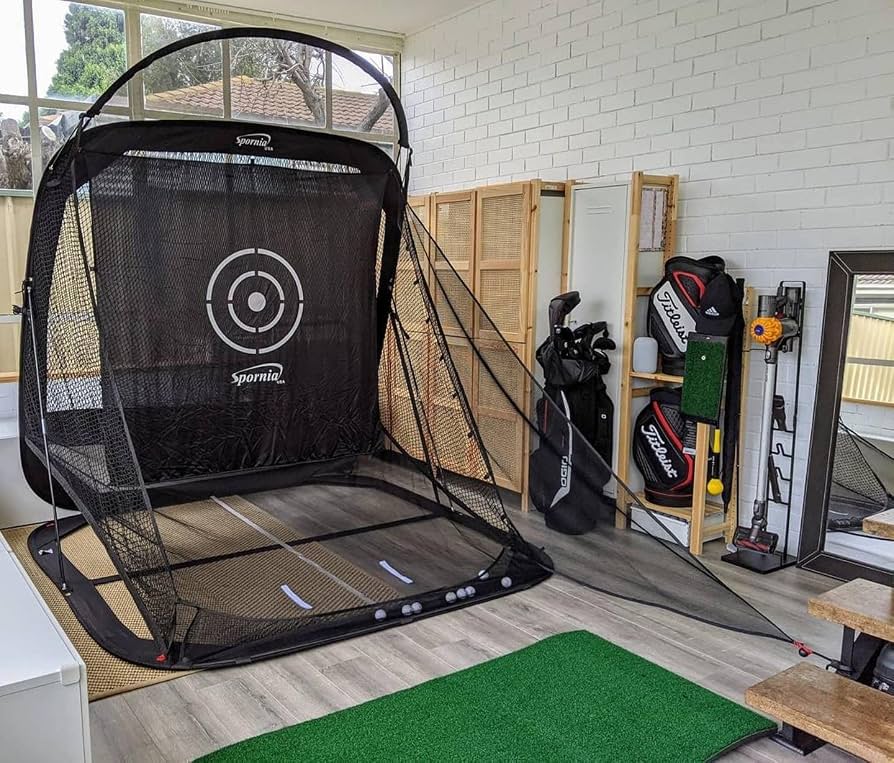
Spornia SPG-7
- 7 ft × 7 ft
- Pop-up, ~30-sec setup
- Automatic ball return
- Indoor + outdoor
The net we recommend first: it pops up in seconds, rolls balls back to your feet, and the target sheet keeps garage sessions quiet enough to be sustainable.
The projector problem
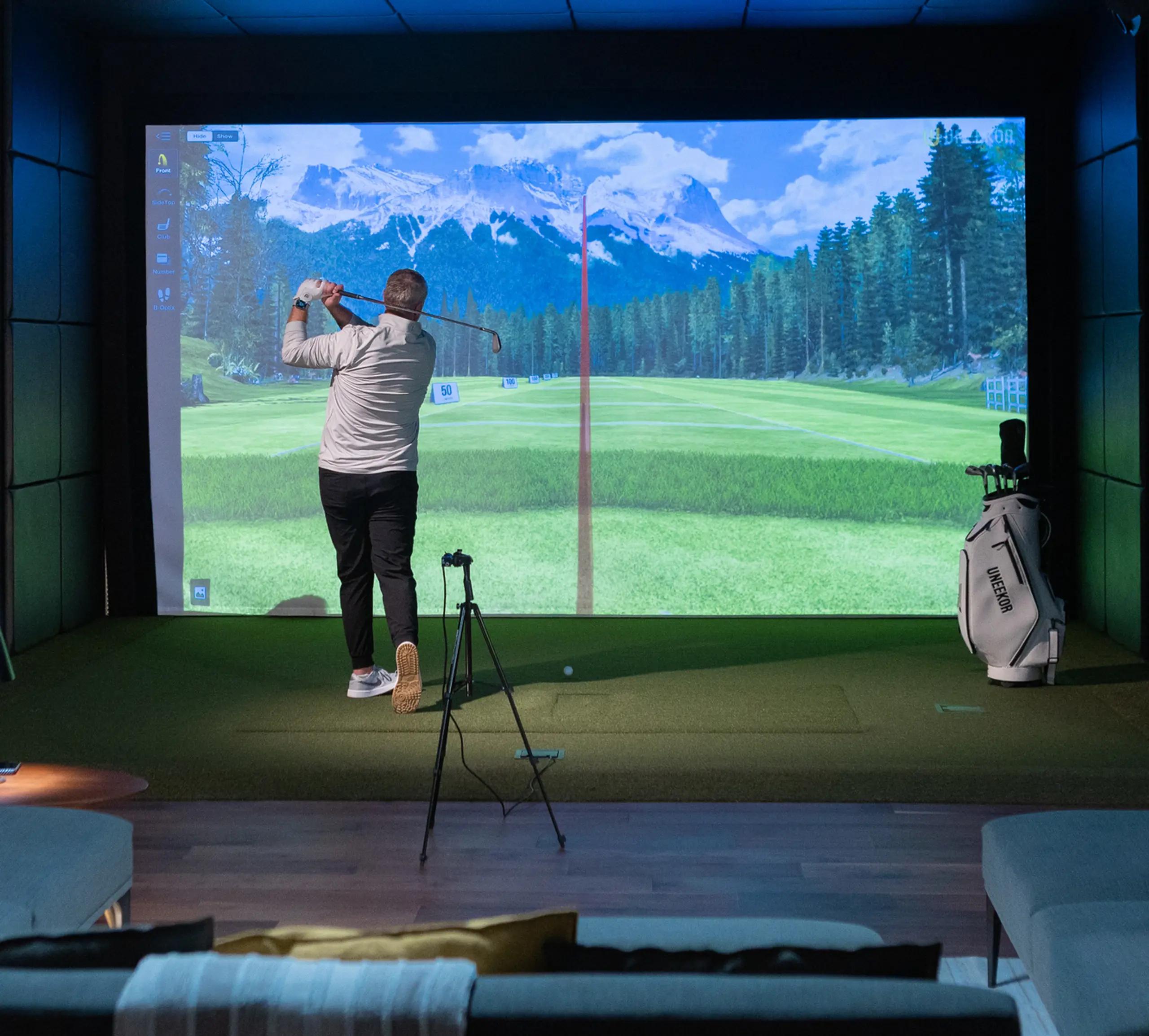
The classic 9-foot mistake is mounting the projector over the hitting mat, where its six-inch drop sits precisely in the follow-through — the one place the club is guaranteed to visit at speed. Two clean solutions. Mount forward of the swing: a short-throw projector at roughly 0.5:1 fills a 10-foot screen from about 5 feet away, which puts it in front of the tee line and out of the arc entirely. Or leave the ceiling alone: a short-throw unit on a stand or in a floor housing beside the screen does the same job with no mount at all. What you cannot do is split the difference and hang it “just behind” the mat. Just behind the mat is the swing.
The Lab verdict
At 9 feet: a floor camera unit beside the ball, the SPG-7 or SPG-8, the best mat you can afford, and a short-throw projector mounted forward of your swing — or a television, proudly. Skip overhead monitors entirely. And if your driver grazes the tape in testing, believe the tape: make it an irons room, keep the driver for the range, and do not fix the problem by shortening your backswing. A simulator that changes your swing is worse than no simulator — the whole point of the room is a swing that still works on the 72nd hole.
Ceiling settled, the rest of the plan lives in our three simulator builds and the free Home Sim Buyer’s Checklist — which begins, not coincidentally, with a tape measure.